
AC/DC of all things 🤘
Lessons in a blast from the past

Hello, Friends:
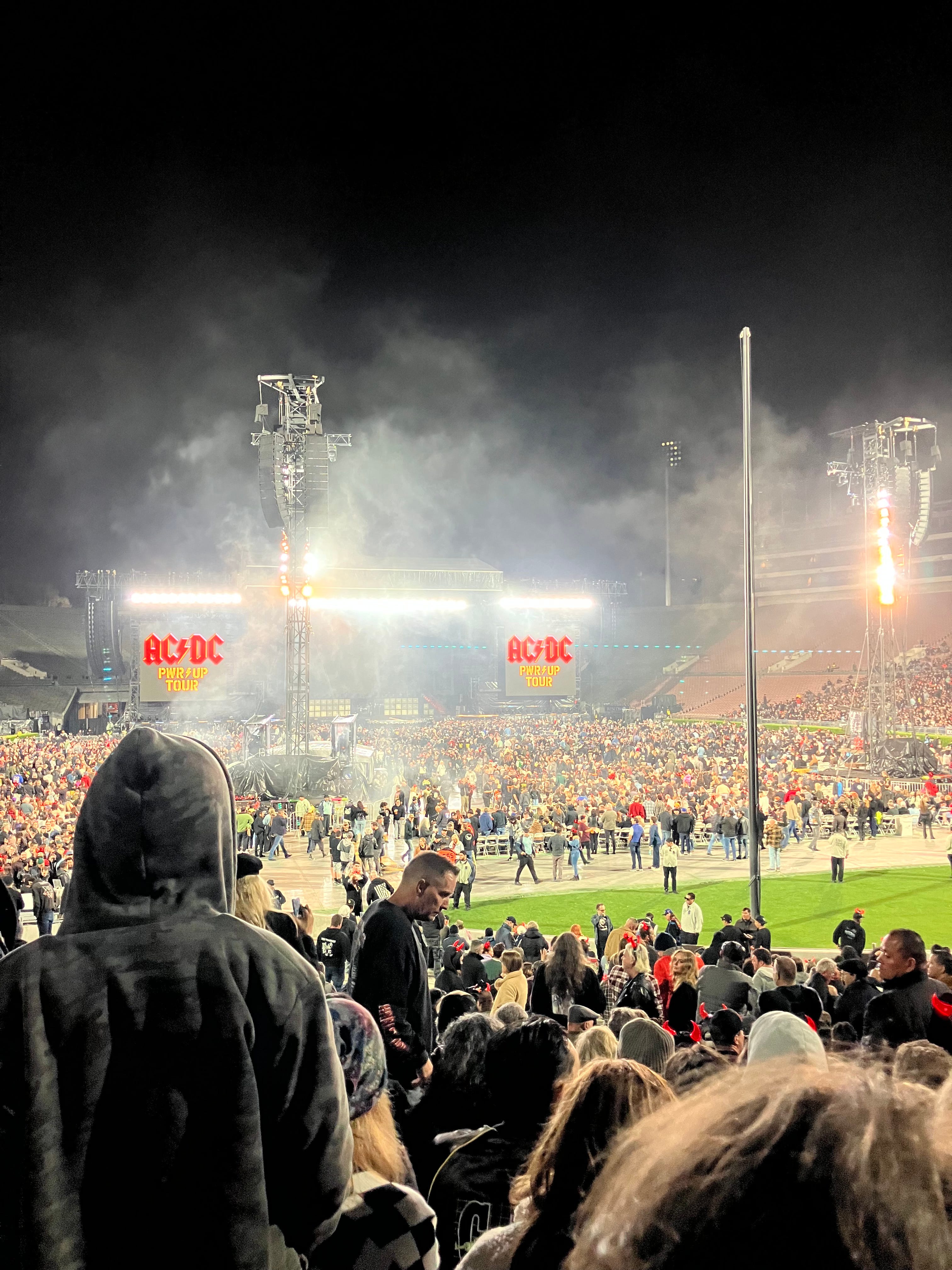
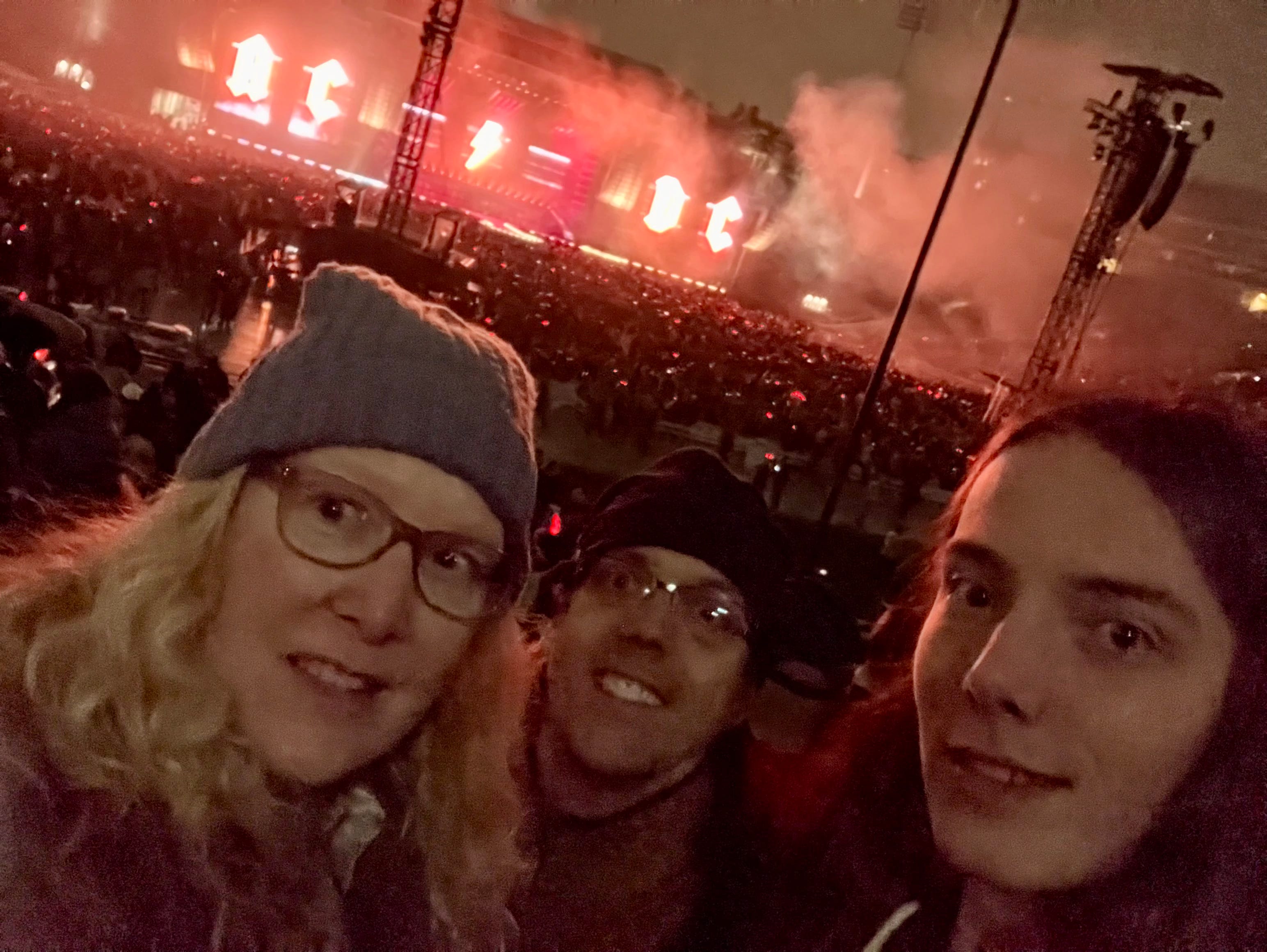
We had a fun full-circle experience last month owing to Tibo’s interest in seeing AC/DC perform at the Rose Bowl Stadium in Los Angeles.
He’s fifteen years old and connects with the music of our youth in the most befuddling, unironic way. I recently noted his head bobbing at the breakfast table, and when I asked what he was listening to he pulled his headphones away from one ear so I could make out the Beastie Boys’ “You’ve Got to Fight for Your Right to Party.” I approve, obviously—I wasn’t much older than he is now when that song gave LOUD voice to one of my generation’s most impactful messages—but this isn’t how it’s supposed to work, is it? He also has Aerosmith and Guns N’ Roses on his playlist. How am I supposed to honor the teenage need to individuate when he’s individuating into some hybrid of his parents’ former selves?
I thought I might get him on track by showing him that adorable video of Chappell Roan singing “Pink Pony Club” in the car with her parents, but he’d never even heard of Chappell Roan.
At any rate, AC/DC was a blast once I remembered how to regulate my heart rate in a sea of 60,000 people, the majority of them male, easily half of them wearing blinking red devil horns, many of them old enough to have raised me. The woman seated beside me brought her oxygen tank with her. The young couple in front of us looked to have stepped right out of my high school yearbook (Class of ‘89 🤘). The family beside them included a maybe ten-year-old child who knew all the words to every song AC/DC’s lead singer Brian Johnson struggled to screech.
The OG members of the band looked their age but brought it. Several people who know me well expressed surprise that I’d care to see such a blaring, coarse, unapologetically alpha male band. I guess I do present as sensitive, and perhaps a tad alpha male intolerant. But I’m nothing if not a child of the ‘80s, and dancing to bands like AC/DC in school cafeterias wore a groove down the center of my soul where electric guitar licks will always have a home. It was a memorable night and worth every second in LA traffic, from “Back in Black,” to Angus Young duckwalking across each song, to a closing fireworks display.
Twice during the show, two different men leaned on me to maneuver along the bleacher seating back to their places, presumably after having visited the restroom or concessions. I mean they literally put their hands on me and used my body to steady their own. It was too loud for them to ask my permission and too dark and chaotic to communicate with body language or eye gestures. It was a grab-and-go situation. The first time it happened, I couldn’t tell what to think or feel about the unexpected bodily contact. I turned to Tibo to confirm he’d witnessed my supporting role. He had.
“That guy just grabbed me and didn’t even say anything,” I yelled in his ear.
“Yeah, he needed you,” Tibo said.
Damn these kids.
When the second man used my body to make it through the crowd safely, again without asking or acknowledging, I did know what I thought and felt about it. I thought it was fantastic to be enjoying a night of rock ‘n’ roll together, and it felt unequivocally good to be of help.
There’s a time and a place for individuation, and AC/DC isn’t it.
One of the regular features on my blog is an advice column for life story and memoir writers called Life Lines. The most recent Q&A is about whether trigger warnings are necessary in books that explore sensitive or troubling topics. I think this column could be of interest not just to writers but also readers, so I’m including it in full here just this once.
Q:
I wrote a biography about my mother’s life, Ida’s Secrets. After reading it, a couple of people mentioned that certain sections of the book were difficult to read. The book does address topics like trauma and suicide because those were realities in my mother’s life.
I’m currently writing a book of historical fiction that has several equally "dark" chapters. What do you think about content that could trigger some readers? Should there be some type of warning? I never want to hurt anyone, and yet there’s so much that could potentially impact a reader. —Grace Bubulka
A:
My short answer to your question is that it depends on your intended audience. If your intended audience is fellow trauma survivors, for example, I don’t think you need to warn the reader about trauma content. But if your intended audience is your young grandchildren, such as in a book of life stories or a memoir, and you write about personal or family trauma, you might want to prep them with a warning at the start of a book or project.
Our offspring often don’t see us as multidimensional people, especially before they’ve reached adulthood themselves, so it could be useful to include a trigger warning or preface that primes them for what’s to come and reminds them of your humanity. And then there’s this regarding family members: Your story is also their story. It’s a good rule of thumb to keep that truth close to heart as we write and present our personal stories to family. I don’t mean we ought to censor ourselves; just that if we want our personal stories to be received with understanding, it’s best to write them with the same.
I posed your question to my life story writing students, who write and hear sensitive and difficult stories every time we meet—such is the nature of honest autobiographical writing. The consensus in that group was that trigger warnings on books are unnecessary. That’s what book descriptions are for, the class generally agreed. Plus, several people pointed out, the reader has the right and the ability to set a book aside temporarily or abandon it altogether if it gets too intense.
Many of us shared the experience of finding written stories about emotionally difficult topics easier to consume than similar stories delivered through film and television. The latter tend to be faster paced and can overwhelm not just the viewer’s emotions but also the senses of sight and hearing. In addition, movie posters, television stations, and streaming services don’t offer thorough content descriptions. Trigger warnings on the screen serve a greater purpose.
I’m currently working with a memoirist, Scott Taylor, who includes ratings at the start of his chapters to indicate their level of gruesomeness. Scott worked in the mortuary business for many years, so you can imagine the stories he gathered. The intended audience for Scott’s book (working title Dead Body Guy) is readers who enjoy gore and death-adjacent topics, so the rating system might not be absolutely necessary. I do, however, think he’s providing a kind service for any unsuspecting readers. His ratings also add a fun dimension to the book.
Speaking of kindness, we writers make lots of decisions out of consideration for our reader. We use proper grammar, we write clear and easy-to-follow sentences, we fact-check our own memories, we build suspense, we punctuate dialogue, we insert paragraph breaks, we come up with catchy titles, and the list goes on. We do most of the aforementioned on autopilot—that’s just what writing is. But the reason we’ve trained ourselves to write in this way is out of care for our reader. We write so readers will understand. We use techniques that enable them to enjoy our work. If you feel your reader will be best served by a trigger warning, Grace, consider it a kindness.
One more thought on kindness. Your readers care about you as well, especially the readers who know you personally. When someone tells you it was difficult to read parts of your book, that isn’t necessarily a criticism or a cry for help. That could be the reader’s way of letting you know your book moved them. It could be their version of letting you know they care about you and, by extension, the circumstances your mother endured and overcame in her life.
A word on fiction, which is what you’re working on now. While I don’t write or edit fiction, I do consume it. I remember reading a trigger warning at the start of Saba Tahir’s YA novel All My Rage. I loved this book, but I did contemplate setting it aside at one point when its adolescent protagonist was experiencing unbearable stress and pain. I think Tahir’s decision to warn her young adult readers at the outset about the book’s more distressing content was a responsible one. This is how the warning appears in the front matter of All My Rage:
Dear Reader,
Please be aware that All My Rage contains content that may be triggering. For a list of content, please see the next page.
Then, on the next page:
All My Rage contains the following content: drug and alcohol addiction, physical abuse, Islamophobia, mentions of repressed sexual assault, tense exchange with law enforcement, death.
If you feel strongly for or against trigger warnings in books, or if you’ve included one in your own book, tell us about it in the comments section of my blog post.
Life Story Writing Workshop in Madison in August!
I’ve long wished I could take a class with Michelle Wildgen or Susanna Daniel at their Madison Writers’ Studio in Madison, Wisconsin. Now, they're hosting one of my workshops! If you live in the area and would like to hear about and explore the benefits of writing about your own life, please join me on Saturday, August 2. I’ll provide refreshments, and participants will take home a copy of my book How to Begin Writing Your Life Stories, as well as a life story notebook and pen. Click HERE for the registration link.
Office Hours for Authors — an affordable way to ask questions and brainstorm
Authors can now purchase and book one-on-one office hours through my website HERE. I’ve blocked off a few 45-minute slots each week to offer authors an affordable way of asking anything about book writing or publishing. I love hearing about books of all kinds, and I offer the perspective of a traditionally published author, a self-published author, an editor, and a publishing services professional. If I don’t have an answer to a question at my fingertips, I’ll find it.
Yours in putting memories on the page,
Sara
I love this. AC/DC was part of the fabric of my youth. When I was 19, I wouldn't date a guy who didn't own a copy of Highway to Hell. I remember the night Bon Scott died because a guy from our friend group came and pulled me and my best friend Kathy out of school to tell us. They were IMPORTANT. :)
Regarding the man using you to pass to his seat: Tibo just knows how to literally cut through the noise to access the truth without judgement. Love this!
Truth be told, I'm listening to Rage Agaisnt the Machine as loud as possible with the windowns down when driving, It feels right for the time!